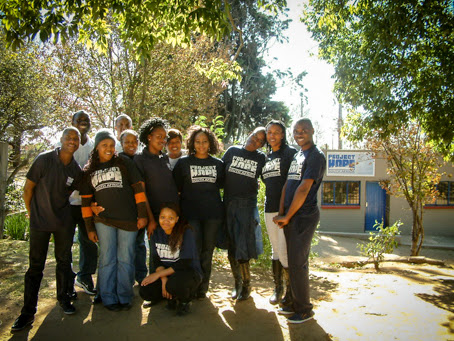
Our Clinic Staff

On Average, we see about 40 patients a day in our clinc at Zandspruit.

The Clinic

Patients can schedule appointments to limit their waiting time.

Educating Patients

Calsses are held daily to assist our patients in achieving healthier lifestyles.

Our Community Garden

Ladies within the community tend to our gardens. The produce is sold to local businesses.

Showing posts with label HOPE Centre. Show all posts

Mandela Day – Make a difference, Join us


“What counts in life is not the mere fact that we have lived. It is what difference we have made to the lives of others that will determine the significance of the life we lead”
– Nelson Mandela

What is ”Mandela Day”?
Information from the Nelson Mandela Foundation:
M
andela Day is a global call to action for citizens of the world to take up the challenge and follow in the admirable footsteps of Nelson Mandela, a man who transformed his life, served his country and freed his people. Its objective is to inspire individuals to take action to help change the world for the better and in so doing, to build a global movement for good.

”Take action, Inspire change – Make every day a Mandela Day” - These inspirational words from The Nelson Mandela Foundation encourage each one of us to simply do good every day, living Nelson Mandela’s legacy and helping to build the country of our dreams. Mandela Day is dynamic and ever-changing: it belongs to everyone and can take place anywhere, at any time.

Nelson Mandela International Day was launched in recognition of Nelson Mandela’s  birthday on 18 July, 2009 via unanimous decision by the UN General Assembly. It is more than a celebration of Nelson Mandela’s life and legacy. It is a global movement to honour his life’s work and act to change the world for the better.

The HOPE Centre supports Itsoseng in honour of Mandela Day, 17th July
Project HOPE South Africa is supporting Itsoseng, an informal settlement in the outskirts of Johannesburg, in honour of Mandela day on the 17th of July by reviving their community garden. Project HOPE aims to plant herbs and provide training to community gardeners to make the revived garden sustainable.

Health awareness is already a key focus for Project HOPE’s HOPE Centre staff and we are constantly identifying ways to raise awareness in new communities. The Mandela Day project in Itsoseng is no exception:

”We already have a success story from Kopano Garden in Zandspruit where community members and patients from the HOPE Clinic are involved, working together to make some extra money, learn about gardening, and for most; to better their health”. We see a high interest for creating the same in Itsoseng and want to make it happen.” – says Portia Zulu, Health Education & Training Officer for Project HOPE South Africa.

We are hoping for a high level of interest on Mandela Day – from both community members and volounteers. The aim of the project is to revive the community garden and train community members on how to take care of their garden so that it is sustainable. The aim of the garden is to promote a healthy lifestyle, reduce food security issues, and create an income for the garden members.

We need YOUR help to make this happen!
To turn this piece of land into a sustainable and lush garden of herbs, we need your help! The 17th of July, in honour of Mandela Day, is the day when the transformation is happening.

So, do a good deed and make a difference for the community members in Itsoseng! Come and help us transform this land and hand it over to the community.

We are in need of sponsors and donations
Our goal is to make this a sustainable project which means we are in need of kind sponsors and donations, both for Mandela Day itself and for the long-term.

If your company or organization sponsors the Itsoseng Garden, we are happy to show everyone our gratitude on social media and on our website in appreciation.
See the list of what we need here:

Thank You!


Please contact Refilwe or Portia to let us know of your interest in contributing or for further questions or information.

Refilwe Lechoba – HOPE Centre Program Coordinator
Email: rlechoba@projecthope.org
Phone:
010 210 7335/ 076 133 8426

Portia Zulu - Health Education & Training Officer
Email: pzulu@projecthope.org
Phone:
079 021 3804 


World Diabetes Day Almost Here

image courtesy of patienttalk.org

Join us as we celebrate World Diabetes Day on 15 November at the Emthonjeni Community Centre in Zandspruit from 9h00-15h00 for:
  • Free Health Checks
  • Circumcision Advice & Bookings
  • Foot & Eye Exams (for patients with diabetes)
  • Healthy Lifestyle Education
  • Cooking Classes
  • Exercise Classes
  • Community Gardening
We'll see you there!


Project HOPE South Africa attends PHASA Conference

PHASA (Public Health Association of South Africa) Conference Info
http://www.phasaconference.org.za/

Conference Date: 03rd – 6th September 2013
Conference Theme: Towards a healthcare revolution - Dignity, rights and quality
Place: The Ranch, Polokwane

Project HOPE staff Lebo Molete and Melikhaya Soboyisi were among approximately 200 delegates from several countries who attended the 10th annual PHASA conference. Delegates represented academic institutions, government health departments, research organisations, non-profit organisations, consultants and independent health care providers.

Melikhaya presented a poster on the HOPE Centre model which attracted a lot of attention, questions and discussions during and after his poster presentation.

PRESENTATION HIGHLIGHTS

Project HOPE was the only NGO to present evidence based findings of a unique NCD intervention

The Project HOPE presentation won the best poster presentation accolade in its category (NCDs) and received a prize

Melikhaya received a nomination and votes to become the Treasurer in the JUPHASA executive committee for the next year


Educating Our Patients


Over the past two months, the HOPE Centre has been focusing on educating patients about diabetes and/or hypertension.


Portia Zulu and her team of Peer Educators discuss the work they've been doing.  As Health Education Manager, Portia equips the team to educate others by passing on her expertise in nutrition and health. 
Portia | Health Education Manager

Currently, the Education Team is implementing a program, 5 Steps to Self Care, that equips patients with knowledge about their health and stresses the importance of knowing their numbers. 

"The program answers questions such as: What is hypertension?  What are high numbers?  What are low numbers?  And what are the warning signs I should look out for?" Portia explains.  "It also teaches people what they should and shouldn't eat."

The 5 Steps to Self Care walks patients through basic understanding of diabetes and hypertension, nutrition, as well as exercise.  Overall, the course is 25 sessions and includes hands-on lessons like cooking demonstrations and exercise classes.   

"We haven't decided for sure, but we are thinking we'll hold Zumba classes for the exercise portion of the program," Portia says.

Another program sponsored by one of our partners, Lily, is Conversation Maps.  Intended to get patients talking and asking questions, Conversation Maps highlights common lifestyle choices and how these decisions affect diabetics.  Topics such as portion control, proper exercise, and myths surrounding diabetes are discussed.  Portia explains some of the ways that a patient's culture may affect his lifestyle choices.  For example, large family gatherings with plenty of unhealthy foods are common, and a patient may feel obligated to partake.  She also explains that providing people with accurate information about diabetes is essential.  When a patient begins feeling the negative effects of diabetes, she may visit a traditional healer instead of seeking medical attention, which can lead to ineffective treatment or no treatment at all. 
Portia shows off the program, Conversation Maps

But these programs alone are not enough.  A motivated and educated team is required to bring this valuable information to our patients.  Portia and team of three Peer Educators work to bridge that gap and to make this information applicable and easy to understand. 

Xolelwa | Peer Educator
Xolelwa teaches two classes every week -- one for the HOPE staff and one for community members.  Even though her community class is just starting up the 5 Steps to Self Care, she sees that the students are eager to learn and contribute. 


Jeff | Peer Educator
Jeff also has two classes, and is excited to report that his class of community members has an attendance of 80%.   Jeff recognizes the hard work of his students.  "One of the ladies that attends is beginning to pay attention to what she eats.  While at a big family event, she chose healthy foods," he says.

Donation | Peer Educator
Donation's two community classes are also thriving.  "They ask many questions and even want to invite friends," he says.  One of Donation's classes is held on Saturdays.  The team explains that patients will often have jobs that keep them from attending during the week.   

The members of the Education Team are diverse, come from various backgrounds, and speak different languages.   They explain that this comes in handy while teaching the classes, as English is not the first language of many of their students.

Flexible and motivated, this power team is determined to educate the HOPE patients and push them towards healthier lifestyles.


But their work doesn't stop there.  They are also to determined to practice what they preach.  Going through the 5 Steps of Self Care themselves, the team is implementing healthier choices in their own lives.

As of now, there are 90 people participating the 5 Steps to Self Care program, and the team expect numbers to continue to grow.  

Time to take a dose of my own medicine!


So I have a confession to make. The past few weeks I haven’t been feeling particularly well. Lots of headaches, dizziness; in particular when working out at the gym; sometimes feeling like my heart is going to explode out of my chest.
To put this into some sort of context I run a large scale, community based diabetes and hypertension program on the outskirts of Johannesburg for Project HOPE. As the boss of a team of ten staff, I try to be a role model to them and to the hundreds of patients we see monthly. Part of my role is to educate patients on the signs and symptoms of chronic diseases such as diabetes and hypertension, tell them how they can improve their lifestyles which will in turn improve their health and either reduce their risk of getting one of these diseases, of help improve their control of the disease.
I know what range your blood pressure should be in, what it does to your body when its too high, what uncontrolled sugar in your bloodstream can do to your eyes, nerves, and kidneys. I’m no expert, no doctor, but pretty well versed in these things as its my job.
So maybe you can see where this is going? After lots of putting it off I  make an appointment to see our doctor at our local private clinic. I go and explain to the doc my symptoms, thinking that its low blood sugar as its happening at the gym (I don’t eat before working out). She knows what I do for a living so we talk, she takes some blood and then I go lie on her couch for my blood pressure reading. “Stefan”, she says, “your blood pressure is 160/110!” “Ahhh,” I say, putting all the pieces of the puzzle together in my head. She tells me that we will wait for the blood results, not to exercise for the next couple of days and see her a few days later for a repeat blood pressure reading.
The next couple of days bothered me. I was wondering why me? I exercise 4-5 times per week. I am not obese, but ok, could stand to lose a few pounds if I am honest. I may drink 2-3 beers per week. Have no immediate family history of high blood pressure. Sure like my food, but love fruit, eat veg and if I am honest have a fondness for MacDonald Big Mac burgers! I also started to think about epigenetics – was there an environmental occurrence in-utero that could have impacted my kidneys which predisposes me to greater risk of high blood pressure? I then start thinking about what my blood test results will be – what will my fasting sugar be like – please God, its got to be preferably below 5.6 mmol/l and definitely below 7.0 mmol/l.
I go back to the doctor with a splitting headache – probably more stress than anything. We go through my blood results – I recognize most of them as we carry them out on our patients at our clinic. They are all normal. I go lie on the couch at she takes my blood pressure again at its still 160/100. So, to my surprise I have been diagnosed with stage 2 hypertension.
We go sit back at her desk and talk about drug options. Hypertension has been classed as a chronic disease, and if you look at all the literature, the majority of people who start medication for hypertension don’t come off of it. We settle for a combination drug – HCTZ and a beta blocker and a check up in three months time to see if I can come off the medication.
So you might be wondering what the big deal about all this is? Its not like I am going to die, have a really serious illness that’s going to kill me soon. In fact many people in my situation would just and do, resign to the fact that they have high blood pressure, take their medicine and continue with their lives.
Well for me, being an educator I want to see if it is actually realistically possible for me to follow the advice that we give our patients and see if I can improve my health. There is nothing like a dose of my own medicine.
After some research, I decide that it would be good to lose 10kg to begin with. That will take me from 100kg down to 90kg – a 10% weight loss which according to the American Diabetes Association should see improvements in my health. I will follow the DASH (Dietary Approaches to Stop Hypertension) diet – voted in the US for being the healthiest diet to follow by the National Institutes of Health. The basic premise of the diet is to reduce the amount of sugar that you eat – simple carbs, eat healthy fats, lots of starchy vegetables, some fruit and lean protein. If you eat carbs it should be complex carbs – brown rice, whole wheat bread – but still in limited amounts.
Will I make it? I am not sure, but I will give it a good try? Are you in a similar position to me? Would you like to make some lifestyle changes that will see improvements in your health in 2013? Let me know, maybe we can go down this road together - slawson@projecthope.org

Vegetable Gardens


Drew Wallace, a volunteer from the US posts his final blog before going back home...

Time goes by way to fast. It feels like I just got here in South Africa, and already its three weeks later and I’m leaving. I’ve learned so much while here, it’s been an experience completely unlike anything I have ever done before. My whole life has been spent inside the U.S. and this is the first time I have ever been outside that shell of American middle class comfort. As much as Project HOPE and South Africa has given me in terms of experience and unfailing hospitality, I hope I was able to give back just as much of my time and effort to help get the HOPE center ready to see patients, and start to make a positive impact in this community.

While here, I was able to finish up a few different types of gardens, and make instruction booklets for each one. With luck and a little sunshine, the plants will take root and grow, and start producing healthy foods, and maybe inspire some of the HOPE center’s patients to try making their own gardens, and be able to eat a little healthier, and manage their conditions a little better. I wish I could stay around just a few weeks longer, and get to see the fruits of our labor here in South Africa, see the first patients walk through the doors of the clinic, hopefully see the first vegetable gardens start to pop up in the township, but life and school gets in the way, as it so often does.


Anyways, so long South Africa, I hardly knew ya but you taught me so much, I hope I was able to give a little back. Maybe someday I can return, time willing. I know I certainly want to.

 Project HOPE is an amazing organization, and I’m proud and ever grateful that I got the opportunity to volunteer with them. I’m certain that they will make a gigantic impact for the better in this community and I wish them all the best in the future operations of the HOPE center.        

Thanks Drew for all your hard work! If anyone would like to come and volunteer with Project HOPE here in South Africa please contact me on slawson@projecthope.org