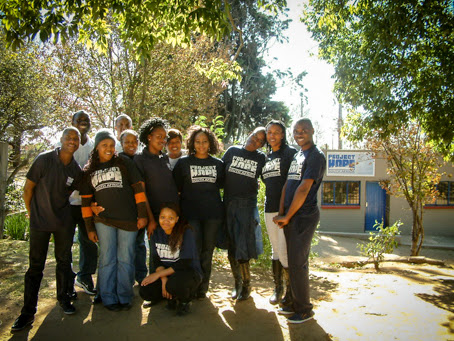
Our Clinic Staff

On Average, we see about 40 patients a day in our clinc at Zandspruit.

The Clinic

Patients can schedule appointments to limit their waiting time.

Educating Patients

Calsses are held daily to assist our patients in achieving healthier lifestyles.

Our Community Garden

Ladies within the community tend to our gardens. The produce is sold to local businesses.

Time to take a dose of my own medicine!


So I have a confession to make. The past few weeks I haven’t been feeling particularly well. Lots of headaches, dizziness; in particular when working out at the gym; sometimes feeling like my heart is going to explode out of my chest.
To put this into some sort of context I run a large scale, community based diabetes and hypertension program on the outskirts of Johannesburg for Project HOPE. As the boss of a team of ten staff, I try to be a role model to them and to the hundreds of patients we see monthly. Part of my role is to educate patients on the signs and symptoms of chronic diseases such as diabetes and hypertension, tell them how they can improve their lifestyles which will in turn improve their health and either reduce their risk of getting one of these diseases, of help improve their control of the disease.
I know what range your blood pressure should be in, what it does to your body when its too high, what uncontrolled sugar in your bloodstream can do to your eyes, nerves, and kidneys. I’m no expert, no doctor, but pretty well versed in these things as its my job.
So maybe you can see where this is going? After lots of putting it off I  make an appointment to see our doctor at our local private clinic. I go and explain to the doc my symptoms, thinking that its low blood sugar as its happening at the gym (I don’t eat before working out). She knows what I do for a living so we talk, she takes some blood and then I go lie on her couch for my blood pressure reading. “Stefan”, she says, “your blood pressure is 160/110!” “Ahhh,” I say, putting all the pieces of the puzzle together in my head. She tells me that we will wait for the blood results, not to exercise for the next couple of days and see her a few days later for a repeat blood pressure reading.
The next couple of days bothered me. I was wondering why me? I exercise 4-5 times per week. I am not obese, but ok, could stand to lose a few pounds if I am honest. I may drink 2-3 beers per week. Have no immediate family history of high blood pressure. Sure like my food, but love fruit, eat veg and if I am honest have a fondness for MacDonald Big Mac burgers! I also started to think about epigenetics – was there an environmental occurrence in-utero that could have impacted my kidneys which predisposes me to greater risk of high blood pressure? I then start thinking about what my blood test results will be – what will my fasting sugar be like – please God, its got to be preferably below 5.6 mmol/l and definitely below 7.0 mmol/l.
I go back to the doctor with a splitting headache – probably more stress than anything. We go through my blood results – I recognize most of them as we carry them out on our patients at our clinic. They are all normal. I go lie on the couch at she takes my blood pressure again at its still 160/100. So, to my surprise I have been diagnosed with stage 2 hypertension.
We go sit back at her desk and talk about drug options. Hypertension has been classed as a chronic disease, and if you look at all the literature, the majority of people who start medication for hypertension don’t come off of it. We settle for a combination drug – HCTZ and a beta blocker and a check up in three months time to see if I can come off the medication.
So you might be wondering what the big deal about all this is? Its not like I am going to die, have a really serious illness that’s going to kill me soon. In fact many people in my situation would just and do, resign to the fact that they have high blood pressure, take their medicine and continue with their lives.
Well for me, being an educator I want to see if it is actually realistically possible for me to follow the advice that we give our patients and see if I can improve my health. There is nothing like a dose of my own medicine.
After some research, I decide that it would be good to lose 10kg to begin with. That will take me from 100kg down to 90kg – a 10% weight loss which according to the American Diabetes Association should see improvements in my health. I will follow the DASH (Dietary Approaches to Stop Hypertension) diet – voted in the US for being the healthiest diet to follow by the National Institutes of Health. The basic premise of the diet is to reduce the amount of sugar that you eat – simple carbs, eat healthy fats, lots of starchy vegetables, some fruit and lean protein. If you eat carbs it should be complex carbs – brown rice, whole wheat bread – but still in limited amounts.
Will I make it? I am not sure, but I will give it a good try? Are you in a similar position to me? Would you like to make some lifestyle changes that will see improvements in your health in 2013? Let me know, maybe we can go down this road together - slawson@projecthope.org

Project HOPE US Board Visit and Dinner

A couple of weeks ago now we had the privilege of hosting a delegation from our Project HOPE HQ in Millwood, VA as well as representatives from the Project HOPE Board.
This team led by Dr John Howe, President & CEO of Project HOPE did a three country two week intense visit with the aim of getting to understand the various programs that Project HOPE runs on the Africancontinent.

We had the privilege of hosting the delegation for a couple of days here in Johannesburg where they were able to come out to Zandspruit and visit our program, get to know our staff, take a tour of Zandspruit on foot to appreciate the complexities of township life as well and to meet with some of our patients at the HOPE Centre clinic. They were also able to visit the City of Joburg Masakane clinic and see some of the challenges that are faced there on a daily basis

The day was a wonderful success with the delegation leaving having a much better understanding of the scope and size of the program and the immense need for Project HOPE to work in Zandspruit and the surrounding area.


After a long day in the baking sun, we all went back to the Hyatt Hotel in Rosebank where Project HOPE hosted a dinner event attended by 100 senior executives who represented all but a couple of  international pharmaceutical companies working in South Africa, government, the NGO sector and academia. The aim of the evening was to highlight the work that Project HOPE is doing around the world in non communicable diseases as well as to specifically talk about our baseline survey findings from the HOPE Centre program here in South Africa.

Very rarely does an event like this occur, and as the diabetes world is fairly small and people usually move from one company to another it was like a big reunion for many attendees!

Dr Howe gave the opening address where he talked about our long history with working together with corporate organisations to improve the health of disadvantaged communities - some of those relationships are over 50 years old.

Ms. Sandhya Singh the Director for Chronic Diseases, disabilities and geriatrics at the National Department of Health shared with us the governments strategy for how they will go about tackling this growing problem of NCDs here in South Africa.

Professor Rheeder then came up and shared our baseline findings from our initial community survey and screening days. If you would like a copy of this then please contact me and I will be happy to post a copy to you.

I then closed off the evening sharing some of the real challenges that diabetic and hypertensive patients face living in a township like Zandspruit.

The dinner was a roaring success with many opportunities now to follow up with companies who would like to come and see our work in Zandspruit and potentially partner with us in the future.


If you would like to come and visit our site please do not hesitate to contact me at slawson@projecthope.org

Thanks for reading!

Vegetable Gardens


Drew Wallace, a volunteer from the US posts his final blog before going back home...

Time goes by way to fast. It feels like I just got here in South Africa, and already its three weeks later and I’m leaving. I’ve learned so much while here, it’s been an experience completely unlike anything I have ever done before. My whole life has been spent inside the U.S. and this is the first time I have ever been outside that shell of American middle class comfort. As much as Project HOPE and South Africa has given me in terms of experience and unfailing hospitality, I hope I was able to give back just as much of my time and effort to help get the HOPE center ready to see patients, and start to make a positive impact in this community.

While here, I was able to finish up a few different types of gardens, and make instruction booklets for each one. With luck and a little sunshine, the plants will take root and grow, and start producing healthy foods, and maybe inspire some of the HOPE center’s patients to try making their own gardens, and be able to eat a little healthier, and manage their conditions a little better. I wish I could stay around just a few weeks longer, and get to see the fruits of our labor here in South Africa, see the first patients walk through the doors of the clinic, hopefully see the first vegetable gardens start to pop up in the township, but life and school gets in the way, as it so often does.


Anyways, so long South Africa, I hardly knew ya but you taught me so much, I hope I was able to give a little back. Maybe someday I can return, time willing. I know I certainly want to.

 Project HOPE is an amazing organization, and I’m proud and ever grateful that I got the opportunity to volunteer with them. I’m certain that they will make a gigantic impact for the better in this community and I wish them all the best in the future operations of the HOPE center.        

Thanks Drew for all your hard work! If anyone would like to come and volunteer with Project HOPE here in South Africa please contact me on slawson@projecthope.org

Cosmo City Screening Day


Drew Wallace, a volunteer from the US, blogs about his first screening event in Cosmo City...

 One of the biggest problems with chronic disease care in Africa is the lack of diagnosis. Most people with diabetes don’t know they have it until they start to develop acute symptoms, blindness, foot ulcers, etc. What we are trying to accomplish with screening days is to identify people who are diabetic and pre-diabetic before they start to exhibit symptoms, so that they can then manage their condition, and never develop some of the problems that arise when diabetes and high blood pressure go too long undetected. At the screening day, people take about 5 minutes to get tested, and if their results show they have diabetes or high blood pressure, we can refer them to a free government clinic to receive treatment or to our  own HOPE Centre Clinic, which ever is closer for them to get to.
                                                                  
One of the great things about South African health care is that medicine is provided free by the government, but the diagnosis and management system is woefully underdeveloped. To highlight this of the 110 people we screened in Cosmo City we found over 50% of people were either overweight or obese which increases their risk of developing diabetes, and 70% of people had hypertension. We also were able to diagnose 7 people with diabetes who came to us with dangerously high blood glucose levels.

Hopefully, through screening events like this we can get more people to be aware of their conditions, and encourage them to stick with their treatment plans, to live healthy and full lives.

First Impressions - Blog from Volunteer Drew Wallace

Drew Wallace, a volunteer from Virginia, USA is here in South Africa for the first time helping Project HOPE South Africa set up its nutrition program as part of the HOPE Centre project. Here is a blog about his first impressions....


So I guess it would be appropriate to start off with a bit about me. This August, I’m going to be a sophomore at The College of William and Mary (Go Tribe!), majoring in International Relations, with a minor in premed focused kinesiology.  I have always been interested in global health and wellness around the world, but in all my 19 years of life, I have never been outside of the continental United States. Sooner or later, this would need to change if I wanted to pursue my dream of helping people around the world lead healthy lives, so I jumped at the opportunity to volunteer with Project HOPE South Africa.

When people think of health problems in Africa, they generally think of infectious diseases, HIV, Malaria, etc. but in actuality, Africa, most specifically South Africa, has the world’s fastest growing diabetic population, and diabetes, as well as the heart conditions associated with diabetes and an unhealthy lifestyle, is the leading cause of death in South Africa. What Project HOPE South Africa is trying to do is establish comprehensive, across the board care for diabetic and hypertensive patients in Johannesburg’s poorest neighborhoods. My role more specifically, is to help develop a nutrition and exercise program, trying to get more people to grow their own vegetables to supplement their diet, and replace fried meats and starches, as well as get out and exercise in the very limited space they have.

Getting off the plane after a 15 hour flight, your mind really doesn’t register that you are now in South Africa, the airport could be in any metropolitan area in the United States, there are no giraffes, no zebras, no lions, just a typical airport terminal. Large parts of Johannesburg would fit in most anywhere in the first world, if not for the ever-present security fences and armed response signs, a constant reminder to this isn’t the suburban Virginia I’m so used to. The contrast becomes even more apparent when you get into the townships, informal settlements like the one the Project HOPE office is located in. South Africa, especially Johannesburg is a country with intense dichotomy, on one side of the road you could have a first world shopping center or a beautiful golf course, on the other side, a village of corrugated metal shacks crammed together along narrow unpaved allies.

The challenge now is to show families how they can grow healthy food in the limited space they have, in order to manage their diabetes. To do this we will be building a variety of demo gardens, and putting together instructions on how to build them, so that diabetic patients can better manage their condition with proper exercise and nutrition. I’m really excited for this opportunity to help out, and hope the new clinic can make a great positive impact on the community!