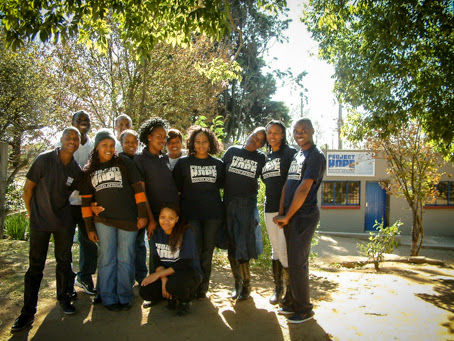
Our Clinic Staff

On Average, we see about 40 patients a day in our clinc at Zandspruit.

The Clinic

Patients can schedule appointments to limit their waiting time.

Educating Patients

Calsses are held daily to assist our patients in achieving healthier lifestyles.

Our Community Garden

Ladies within the community tend to our gardens. The produce is sold to local businesses.

Its all go! The start of our baseline surveys in Zandspruit

The last couple of weeks have been hectically busy for Project HOPE South Africa. I have been looking forward to this for a long time – finally getting to dig down deeper into the community of Zandspruit and sit in people’s home and learn about what the community’s perception is on good health and barriers to good clinical care in the community.
The idea of our baseline survey is to get a good understanding of the community's awareness on the chronic diseases such as diabetes and to collect some prevalence data such as blood pressure and BMI before our activities launch. This will help us to measure the project's impact over time.
 Project HOPE South Africa has formalised a partnership with Project HOPE Mexico to provide technical assistance on this project and it was great to have Courtney Guthreau our Global Diabetes Specialist come and participate in this whole process her team will be helping us develop the training materials that we use in the future.


I was able to interview and hire 20 young residents from Zandspruit to help with this process. Hardly any of them had any real understanding of what diabetes and high blood pressure was, and few had done any sort of surveying before. We spent the first day training on how to undertake a survey and had great fun learning how to weigh each other and take each other’s blood pressure.

Each morning we assembled at our base at Emthonjeni Community Centre had a quick briefing and then armed with our Project HOPE bags full of survey forms, tape measure, scales and blood pressure machine and packed lunches we split into pairs and went to one of the 10 recognised sections in Zandspruit to begin surveying.
Because this is part of a formal research project that we are conducting with the University of Pretoria we had to take a random sample of the community so we used dice to choose which home we would visit!  We would go to a predetermined starting point, get our clip boards out and roll our dice to see if we would sample on the left or right side and then roll again to see which home we would stop at.
For me it was the first time that I had visited certain parts of the community and was taken aback with the numbers of people that are crammed into such a small area and the lack of any real infrastructure. The smell of sewage was in some places very strong running down the middle of dirt paths. A common complaint when talking to people was the issue of access to health care – having to wait for such a long time to be seen by a nurse puts a lot of people off from going to the clinic as well as the lack of money to buy healthier food due to high unemployment rates. Poor living conditions also came up lots.
Yet in the middle of these difficult living conditions you find a people that are very resilient, up-beat and wanting to improve themselves.
Although our results won’t be published for a few weeks, informally we can say that the vast majority of 400 people we interviewed were overweight (a key risk factor for developing diabetes) and many had high blood pressure. We found that a number of people were "tired" a symptom of poor diabetes control, some had lost strength in their hands and feet, some had eye problems and other headaches. All these are symptoms of diabetes and high blood pressure.
With only 15% of diabetes cases being diagnosed it is so important that the community becomes more aware of these diseases and empowered to make choices that improve their health and productivity.

Please check back for regular updates now. We still have our clinic assessment to undertake tomorrow and then another big survey in a neighbouring township this month to conclude all our baseline work.
Remember to like our facebook page (right hand side) to get regular shorter updates!


2011 World Diabetes Congress, Dubai

Greetings from Dubai! I'm attending the World Diabetes Congress which is hosted by the International Diabetes Federation (IDF) every two years bringing together experts in diabetes and other non communicable diseases from across the globe for a week of interesting lectures and workshops. Topics vary from the latest medical research into the development of an artifical pancreas to providing health education on diabetes in rural settings.

I have spent most of my time getting to know the various African diabetes associations, picking up contact details and learning about the challenges that they face as we look forward into 2012 and the expansion of our diabetes work across the continent. I have met people from Tanzania, Rwanda, Uganda, Zimbabwe, Zambia and Kenya all saying that diabetes is a growing problem in their respective countries, and all looking for help to address the various challenges that they are facing. Its a very exciting time to be working in this health area, and particualarly on the continent of Africa which according to the IDF will experience the highest growth rate in diabetes prevalence (90% growth) over the next 20 years and yet at the same time very challenging considering it has the least amount of money available to spend on addressing the problem currently.

Project HOPE has a booth in the exhibition hall and in talking with the various people that have stopped by  it is clear that organisationally we are positioned really well in terms of the need that is out there in the various countries. From both health professional education like we currently do in India as well as looking into innovative ways of getting health messaging and diagnosis and management services across to patients in resource poor settings where health professionals simply arent around such as in rural and urban poor areas of South Africa Project HOPE is working hard to find solutions and bring a better quality of life to those that are currently underserved.

Project HOPE Partners with Eli Lilly and Company to bring Non Communicable Disease Services to Johannesburg

 After a long wait and lots of hard work, I am excited to announce to you today that Project HOPE has secured a five year, up to $3.5 million US Dollar grant from Eli Lilly and Company to implement a non-communicable disease (NCD) project called the HOPE Centre in Zandspruit, Johannesburg,  South Africa.

The Eli Lilly NCD Partnership is a new $30 million, five-year commitment to address non-communicable diseases with Project HOPE and five other non-governmental organization (NGO) partners in four countries (South Africa, India, Brazil and Mexico) around the world. Eli Lilly is launching the partnership, which combines the company’s unique resources with the expertise of HOPE and other leading global health organisations, to identify new models of patient care that increase treatment access and improve outcomes for under served communities.

This is a very exciting time for Project HOPE, as together with Eli Lilly, we work together to find solutions to some of the world’s most pressing health problems related to chronic diseases. Non-communicable diseases in South Africa represent a major challenge to the country, in particular in areas like townships where already existing health services are either overstretched or non-existent.

Together with local community stakeholders, the City of Johannesburg, the University of Pretoria and Eli Lilly, Project HOPE will run the HOPE Centre project, based out of Emthonjeni Community Centre in the heart of Zandspruit which is a township on the outskirts of Johannesburg.

Thank you to all of you who have supported this initiative over the previous months. I cant wait to share with you the developments over the coming weeks.
 
In the mean time if you have any further questions or comments please feel free to contact me on slawson@projecthope.org


Thanks for reading!

Stefan

PS. Remember to "like" us on facebook to get regular shorter updates.  

Follow us on Facebook

Hi All!

In preparation for a very exciting announcement, I have created a page on Facebook that you can now follow. This will be used to post shorter updates, photos etc. If you use facebook, you can now click "like" on the right hand box.

Check back very soon to hear about some exciting news that Project HOPE is going to announce!!!

Stefan

Presentation to the American Chamber of Commerce

A few weeks ago I was invited by the American Chamber of Commerce in South Africa to present Project HOPEs plans for our chronic disease program for South Africa. Project HOPE participates on the HIV/health forum at the Chamber which is made up of representatives from US corporations, US government, NGOs and other interested parties.

It was a good opportunity to make contacts and share our vision for South Africa. To say thank you I was presented with a small gift from Lauren Marks who is the co-chair and who is a Health Program and Public Private Partnership Advisor for USAID.