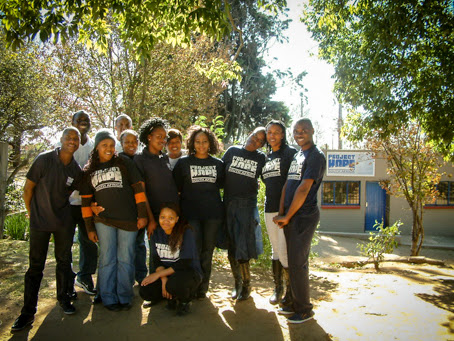
Our Clinic Staff

On Average, we see about 40 patients a day in our clinc at Zandspruit.

The Clinic

Patients can schedule appointments to limit their waiting time.

Educating Patients

Calsses are held daily to assist our patients in achieving healthier lifestyles.

Our Community Garden

Ladies within the community tend to our gardens. The produce is sold to local businesses.

Village Savings and Loans takes off in Zandspruit


In the past I have talked a lot about our Village Savings and Loans (VSL) groups which I have been involved with for the last few years both here in South Africa and in Mozambique. I truly believe that if we are going to make a dent in the prolific spread of NCDs such as diabetes and hypertension we are going to have to start addressing the drivers of the epidemic.
Household disposable income plays a significant role in peoples ability to eat healthy, exercise and undertake preventative health checks.

Project HOPE has launched the VSL concept in our work in Zandspruit. The idea is that we will integrate this program into our Peer Support groups for our diabetes and hypertension patients once we have given them some basic patient education.
I am super excited to see how this approach will transform the lives of our patients and glad that you can share the journey with us.

-Stefan

The HOPE Centre film


During May this year, 10 volunteers from Eli Lily & Co. came to Project HOPE South Africa to share their skills and expertise with the project. The volunteers brought with them a camera crew who spent time in Zandspruit, observing and filming the day-to-day work of The HOPE Centre, the result of which can be viewed on the youtube link above.

Training VSL health activists

Last week Lindsay and I conducted a two-day training course for the VSL health activists.  Thirteen women participated, representing several different VSL groups.  The first day included lessons on diabetes, hypertension, breast cancer, nutrition, tuberculosis, and sanitation and infection control.  The second day covered HIV/AIDS, tobacco related illnesses, maternal health, diarrhoea, worms, and children’s health.  Each lesson gave an overview on the topic and highlighted information relevant to the community, such as prevention measures, symptoms, and healthy lifestyle habits.  Many people in Zandspuit are aware of the health issues covered in the training, but we found that there were a lot of rumours and inaccurate information.  We hope that by attending this training, the health activists will be able to both dispel these myths and educate their neighbours and community.


VSL health activists reviewing material before their final evaluation

At the beginning of the first day we gave the participants an evaluation to judge their knowledge on the topics that were going to be covered.  At the end of the second day we repeated the same evaluation to see how much the women had learned.  Average scores jumped from 43% before training to 84% after the training.  We definitely consider this a success.  Each trainee received a certificate of completion and a packet of information to use while instructing her VSL group. 

Since the training, some health activists have already begun training their groups.  Last Thursday we observed one of the health activists present a lesson on diabetes.  The lesson was well received and even resulted in several members going to the HOPE Centre to be screened. 

Our time here in Zandspruit and Johannesburg is quickly coming to a close.  Both Lindsay and I have thoroughly enjoyed our time and hope to return someday!
Training complete!
Britta Harman

Volunteers Britta Harman & Lindsay Johnson boost the VSL program in Zandspruit


Lindsay and I arrived in Johannesburg on May 12th and will be working for Project HOPE until June 7th.  We are classmates at the University of Kentucky’s Patterson School of Diplomacy and International Commerce and have been looking forward to coming here since December. 


Britta, Tsholo, and Lindsay

During our first week here we got our feet wet by observing and participated in the many components of this Project HOPE site.  We went door-to-door with community screeners, observed mass screenings in various locations in the township, visited the clinic and pharmacy, and attended information sessions on diabetes and hypertension.   


Britta and Tsholo at a VSL meeting
Despite the overall focus of the HOPE Centre on diabetes and hypertension, our focus for our time here is on economic strengthening and its connection to health.  In order to encourage improved economic stability among community members in Zandspruit, the HOPE Centre has established a Village Savings and Loans (VSL) program.  This program has been implemented in other Project HOPE locations, but only began in Zandspruit in March.  The VSL program brings together small groups of friends and community members to participate in “co-banking”.  Groups usually consist of 6-10 individuals and meetings last anywhere from 30 minutes to 3 hours.  Members save individual amounts of money each week and deposit it into the group bank account after each weekly meeting.  Members may take out loans from the account and are responsible for paying them back with interest in an allotted period of time.  Rules and regulations, such as interest rates and fines, are determined by each individual group and recorded in the group constitution.  At the beginning of the saving cycle, groups elect a chairperson, secretary, treasurer, money counters, and health activist.  Ideally, after nine weeks of meetings with Tsholo, the HOPE Centre field officer in charge of the VSL program, groups will be able to run themselves.  After that point, Tsholo will drop in from time to time, but the group officers will ultimately be responsible for running the meetings.  A saving cycle lasts for one year.  At the end of the cycle, all members receive the sum they have saved plus the shared interest that has accumulated over the year.  
Lindsay conducting a VSL baseline interview.
Corresponding with the HOPE Centre’s focus on healthcare, each VSL group is required to elect at least one health activist.  This member is trained by a HOPE Centre employee on pertinent health issues such as diabetes, hypertension, HIV, maternal health, breast cancer, TB, and nutrition.  Once the health activists are trained, they are responsible for teaching one of these lessons to their VSL group each week.  Lindsay and I will be teaching a 2-day training course to roughly 15 health activists next week.  Additionally, Lindsay and I are preparing pre- and post-cycle surveys to track how the VSL program impacts individual members.  The goal of this is to determine if increased savings helps improve the health of the members.  Eventually the HOPE Centre would like to implement the VSL program among the diabetes and hypertension patients at the clinic. 

 Thus far we have had a fantastic experience and found everyone at the HOPE Centre and Zandspruit to be incredibly welcoming.  
Britta Harman


Improving patients knowledge about how medications work

Most of our patients are on chronic, long term medication for their diabetes and hypertension and many of them have to take multiple tablets per day.
 
Adherence rates to these medications is very poor, often because patients are not empowered to understand what hypertension or diabetes is and what the medicine does to help them manage it. We often find that once a patient feels better, they stop taking the medication which can cause long term complications. Patient education is key to combating this.

Ellen leading a training session with PH staff
Ellen Cannady and Nick Wang from Eli Lilly came as part of a 10 person strong team for two weeks to help Project HOPE tackle some of these issues.

As part of their scope of work, they developed some patient education materials on all the drugs that we prescribe so that the patients could understand better what the drug does.

Nick Wang with PH staff

 
They also spent an afternoon with our staff training them on the role of pharmacology in the management of diabetes and hypertension. As a result, our team is now better prepared to answer patient questions about the drugs and support our patients in taking them regularly.
Thanks Ellen and Nick!