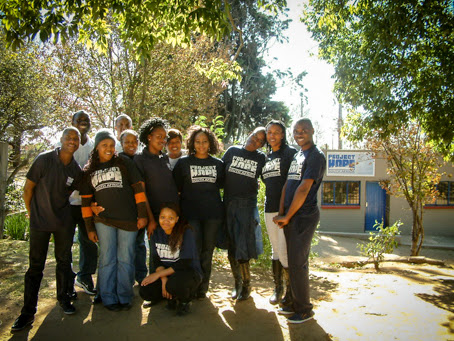
Our Clinic Staff

On Average, we see about 40 patients a day in our clinc at Zandspruit.

The Clinic

Patients can schedule appointments to limit their waiting time.

Educating Patients

Calsses are held daily to assist our patients in achieving healthier lifestyles.

Our Community Garden

Ladies within the community tend to our gardens. The produce is sold to local businesses.

Be Open

Like a lot of volunteers, I did my research ahead of time. On the history, the climate, the healthcare system, the greatest challenges facing the poor.

“I came open,” said one of my fellow volunteers. “Open to help, to do what I need to do, open to the experience.”

Now that I’ve been at the HOPE Centre healthcare clinic located in Zandspruit, an informal settlement in Johannesburg, South Africa, I see that as the better approach. The HOPE Centre provides treatment and education to local residents about health issues, especially diabetes and hypertension.

Unfortunately, openness still won’t protect you from the shock of seeing thousands of shacks leaning against each other for support,  sewage running through the streets, and limited access to basic healthcare, water and electricity. But openness will keep you from being overwhelmed by the magnitude of need. It can actually focus you on the small – but critically important role -- part you play in improving the conditions that day…and hopefully beyond.


At the HOPE Centre, our team of 10 volunteers from Eli Lilly and Company includes medical doctors, pharmacists, diabetes educators, and communication specialists. We are helping conduct diabetes health screenings, improve patient understanding of chronic diseases and medication compliance, and support nutrition education and peer educator training.

It’s a lot to accomplish in two weeks. And it’s still not nearly time enough to meet the needs of patients living in these conditions. But we’re open to what we need to accomplish today. We’re open to the experience. We’re open to making a small difference, however we can, today. And we’re open to the possibility that through the great work of Project HOPE and Lilly, we can collectively make a big difference in the years to come.
Amy Sousa

Amy with Tamer Coskun, a fellow Lilly ambassador volunteering at Project HOPE

So different – or so the same?


I came to the Project HOPE Centre in South Africa thinking that I would not have much in common with the people I would meet here.  How could I?  We live half a world and an equator apart.  In less than a week on the ground, everything’s changed.

For example, I noticed the young 20-something guys who have been working with our team are congenial and chatty, willing to tease and be teased.  They get along well with each other and charm the adults around them.
Where I have I noticed this before?  In my three 20-something sons when all we get together.  It makes me see them in a whole new light.

On our first day, I met one of the clinic staff on our walking tour of the community.  We shared family stories and really hit it off.  I hadn’t seen her for several days, and today when we met up, she put her arm around me and said, “What have you been doing? I’ve missed you.”

Where have I heard that before?  From my best friend at home when we’re both too busy to connect.  It makes me see her in a whole new light.

Lilly volunteer Julie Williams and a new friend in Zandspruit,
who loves to sew as much as her grandmother did.

I spent time today talking with a 72-year-old resident of Zandspruit about the dress she was making.  Next to her she had a bag filled with projects at various stages of completion.

Where have I seen this before?  In my grandmother, who always had a sewing project on her lap whenever she was sitting down.  It makes me see her in a whole new light.

So when the elderly lady told me she has “sugar in the blood” (diabetes),high blood pressure, “takes the pills” (brown, white), and can’t see too well out of her right eye these days, I better understand why our volunteer work here at the Project HOPE Centre is so important.  She is someone’s grandma.

I better understand why it’s important that the young men volunteer at the clinic.  They are someone’s sons.

I better understand why the staff members at the clinic work so well together. They are friends.

Getting to know the people and patients at the HOPE Centre clinic has helped me see them in a whole new light.  In spite of our many differences, the most important things are the same.
 
 
Julie Williams

Press Release - Project HOPE Welcomes Volunteers from Eli Lilly and Company for Two-Week Assignment at the HOPE Centre in South Africa


Project HOPE, a global health education and humanitarian assistance organization, yesterday welcomed ten employees from the global pharmaceutical company Eli Lilly and Company  for a two-week volunteer assignment at  the HOPE Centre in South Africa.  The volunteers will provide assistance to the staff at the HOPE Centre in a variety of capacities, all in an effort to improve the quality of care at the clinic.
 
 
Located in the impoverished township of Zandspruit near Johannesburg, the HOPE Centre clinic is dedicated to the prevention and treatment of chronic diseases, especially diabetes and hypertension.  The clinic not only offers treatment, but it also promotes awareness about chronic illnesses - especially diabetes and hypertension - with an emphasis on prevention.  The HOPE Centre is the only clinic of its kind in South Africa.

Community health workers employed by the clinic go out into local areas to offer screenings for diabetes and hypertension, and they offer access to treatment for those individuals found to suffer from these and other illnesses.  Because many residents of this community do not have ready access to family medicine providers, the clinic also offers treatment for many other common illnesses and ailments.

The ten volunteers starting their two-week assignments today at the HOPE Centre work in a variety of capacities for Lilly including clinical research, pharmaceutical sales, communications and manufacturing.  They have each been assigned to one of five different functional areas of the clinic: clinical support, community screening, pharmacy and lab support, communications and peer support.

 
The Lilly volunteers will be responsible for developing strategies to improve the functioning and efficiency of each of the areas to which they have been assigned.  They will also create educational materials about diabetes, hypertension and the most common pharmaceuticals used at the clinic.  Additionally, some of the volunteers will conduct patient interviews; others will set up small gardens, which will support the nutrition education component of the clinic.

“I am thrilled to welcome so many talented individuals from Lilly to the HOPE Centre,” said Stefan Lawson, Project HOPE’s Country Director for South Africa and Director of the HOPE Centre.  “I look forward to the lasting contributions these volunteers will make to our community.”
The volunteers are part of Connecting Hearts Abroad, Lilly’s global employee volunteer program, which was launched in 2011.  Throughout 2013, Lilly will send 200 employees from 45 countries to impoverished communities throughout the world on two-week service assignments.

About Project HOPE
Founded in 1958, Project HOPE (Health Opportunities for People Everywhere) is dedicated to providing lasting solutions to health crises, with the mission of helping people to help themselves. Identifiable to many by the SS HOPE, the world’s first peacetime hospital ship, Project HOPE now conducts land-based medical training and health education programs in 35 countries across five continents.
http://www.projecthope.org

About Eli Lilly and Company
Lilly, a leading innovation-driven corporation is developing a growing portfolio of pharmaceutical products by applying the latest research from its own worldwide laboratories and from collaborations with eminent scientific organizations.  Headquartered in Indianapolis, Lilly provides answers – through medicines and information – for some of the world’s most urgent medical needs.  Additional information about Lilly is available at www.lilly.com .

Media Contact

Geraldine Carroll  Tel. 540.257.3746  gcarroll@projecthope.org


Familiar healthcare challenges in a rewarding new environment


When I moved to South Africa a few months ago, I knew that I wanted to get involved as a volunteer with one of the many wonderful organizations promoting health in this country where so many people face enormous barriers to health and wellness.  I am so happy to have found Project Hope where I’ve been able to take part in the wonderful work they are doing in the Zandspruit township near Johannesburg.

The project I began when I started working at the HOPE Centre clinic in Zandspruit was an inventory tracking system for the clinic pharmacy.   In this busy clinic, open 3 days per week, patients are primarily seen for the treatment of diabetes and hypertension.  However, nurses also address common illnesses/ailments as many patients do not have ready access to family medicine providers.  Thus, the clinic pharmacy is as busy as the clinic and stocks a wide array of medications to treat patients.

As I started the process of building an inventory system that could be implemented in the clinic pharmacy, I was struck by a number of similarities between the challenges I saw in this clinic in South Africa and other healthcare practice environments I’ve worked in.

The first was the challenge of ensuring that the clinic was able to stock the right number of the correct supplies to meet the variable demand created by patients coming in with an unpredictable set of symptoms and conditions.  This is a challenge almost all providers face but especially so here where the clinic attempts to keep all medications on-hand and not create another barrier to care by sending patients out to a pharmacy with a script.

The second is that in order to match supply with demand as effectively as possible, record-keeping must be accurate and detailed enough to inform regular purchases/ordering for the clinic.  As I evaluated the barriers to getting this data at the HOPE Centre clinic pharmacy, I was met with the familiar “paper problem.”  Records were kept on paper and not electronically in a form that could be used to easily evaluate how many and what kind of medications were being used each day at the clinic.

Finally, across most healthcare practice environments, the detailed and sometimes monotonous tasks of collecting data, evaluating that data, and making decisions based on it are not what most healthcare providers want to, nor should spend their time doing.  Their valuable time is better spent with patients:  educating, treating, and providing care.  While the behind-the-scenes tasks are important, it is important and often a significant challenge to ensure that providers receive the support that they need to do their jobs seamlessly and maximize the time they are able to spend with patients.

With an inventory system now in place that will help address some of those challenges, I hope that the HOPE Centre clinic in Zandspruit will now be even more efficient and able to treat more patients who I know greatly appreciate the much-needed and high-quality care Project HOPE is providing in this community.

Julie Brink

South Africa experience by Jo Burt


It’s hard to believe that our two months in South Africa have already ended.  The time went so fast and I am sure that is because we were so busy all the time.


Jo busy in the Hope Clinic
Working with Project Hope is a life changing experience and exposes one to a cultural exchange that provides insight and understanding at a level unparalleled.  Being able to walk in another person’s shoes and see what life is like for people living in poverty and deprivation provides an education that cannot be gained otherwise.  The entire project is focused on teaching healthcare professionals and community health workers to treat, diagnose, and prevent diabetes and hypertension.  The project enables the local people to be able to find long term solutions to improve the health status of the people in their communities.


The Emthonjeni Hope Centre Clinic is a great asset to the community and provides easy access to treatment and care that in the past has not been accessible to the residents of Zandspruit. Whilst in Zandspruit we met a 50 year old gentleman who had suffered a stroke while at home alone. Health Care Workers from Project Hope happened to be making a pre-clinic visit to this particular man’s compound and found him with symptoms of a stroke, including hemiplegia, and unintelligible speech.  They were able to get emergency care to him and when he was released from the hospital, he was referred to the Hope clinic.  In a short period of time he was walking on his own, and has now fully recovered the use of his arm and has a near normal blood pressure with minimal medication.  He attributes his life and recovery to the clinic.  He truly believes that if Project Hope had not been in the community, he would not be alive today. 


Jo's sister and fellow exchange nurse: Dot, organising medication.
Much of our time spent working with the Project was organizing the clinic, helping to streamline processes and improve the timeliness of visits.  Upon arrival at the project, the clinic often had wait times for patients of several hours. The implementation of new processes has been successful in decreasing the appointment wait times to less than 60 minutes which was a goal for the clinic.  Streamlining procedures for drawing blood for lab tests has helped to decrease wait times so that most patients are waiting less than 20 minutes and the process for the Family Nurse Practitioners (FNP’s) is much smoother.  Improving the ability for the FNP’s to see more patients is an important step to providing more patients with services.
Jo and Dot training volunteers how to test glucose levels

In addition to the improvement in the clinic, it has been important to evaluate the services and provide assurance intended outcomes are being achieved.  Data collection, collation and analysis of the data are an integral part of this project.  This work will be ongoing, but has already demonstrated that treatment  for hypertension has been successful.  Also, there is a decrease in the glycosated hemoglobin’s for the diabetic patients. 

It has been a tremendous privilege to participate in this project and I will never forget the wonderful experiences.  Seeing a 22 year old mother with four children under the age of 5 with a blood pressure of 200/120 and being able to get her on medications that may save her life was very rewarding.  Having a 35 year old gentleman come to the clinic with a blood sugar of 25.1 mmol/l and being able to get him medications and education to help manage his diabetes was a testimony to the importance of the clinic.  There are multiple stories of this type that have provided meaning and importance to the project. 


Zandspruit resident screened by Jo & Dot's team
One of the other great benefits of this project is the fact that local people are trained and become employed by Project Hope to sustain this project.  Not only does the project provide much needed employment for several people, it is strengthening their self esteem, providing value to their lives, and helping them to become advocates for their patients and the clinic.  It has been a genuine privilege to be able to provide leadership and development for these young people and to know that their lives will be improved for this opportunity.


Zandspruit scene
I cannot personally say enough about how much meaning this project has brought to my life.  There are so many skills that I have been able to develop and improve and the cultural exchange has been immeasurable.  I will never forget the people I have grown to love.  I hope that I have been able to make a small contribution to the Project and I know that the Project has had a life changing effect on me.


Jo & Dot with volunteer screening team about to head out in to Zandspruit